
KNOWN primarily as a training site among cave divers, Gouldens Sinkhole in Mount Schank has seen thousands of students explore its cold and normally murky waters since its first underwater exploration in 1963.
On June 30 of that year pioneering local cave divers Philip “Mick” Potter and Lawrence “Snow” Raggatt explored the sinkhole’s tranquil and enticing underwater regions.
According to veteran cave diver and Cave Divers Association of Australia (CDAA) life member Peter “Puddles” Horne, conditions were not the best and Mr Potter noted the visibility was very poor.
Mr Horne said the sinkhole later attracted hundreds of budding cave divers as the new recreational pastime of scuba diving became more popular.
“With the popularity of cave diving increasing the need for a suitable training and testing venue in the Mount Gambier became a necessity,” he said.
“The picturesque spring systems of Piccaninnie and Ewens ponds were originally used for training, but later conservation considerations showed a more suitable site had to be found.
“Consequently, Gouldens was assessed as being the best sinkhole in which training and testing could take place.
“When the CDAA was formed in 1973, the sinkhole was given a basic – category one (nowadays deep cavern) – rating because it was a relatively shallow, conical cave feature with no major
underwater passages and only a couple of restrictive areas.”
As a large enclosed cavern in porous coralline limestone it formed through the solution processes of slightly acidic rainwater until the roof collapsed creating the open sinkhole (cenote) seen today.
Mr Horne said the hole was named after Reginald H. Goulden who purchased the property immediately to the east of it through the Soldier Settlement Scheme in 1949.
He installed a pump several metres from the water’s edge to provide a virtually limitless water supply to his crops and in doing so installed one of the first irrigation systems of its kind in the area.
Like many of the other large waterfilled sinkholes of the region, Gouldens was first discovered by Europeans in 1844 when Governor Grey explored the area.
A large walk-down ramp – 30 metres long and 18 metres wide – was cut in the sinkhole’s southern wall (probably before the turn of the century) presumably for stock to gain access to the water.
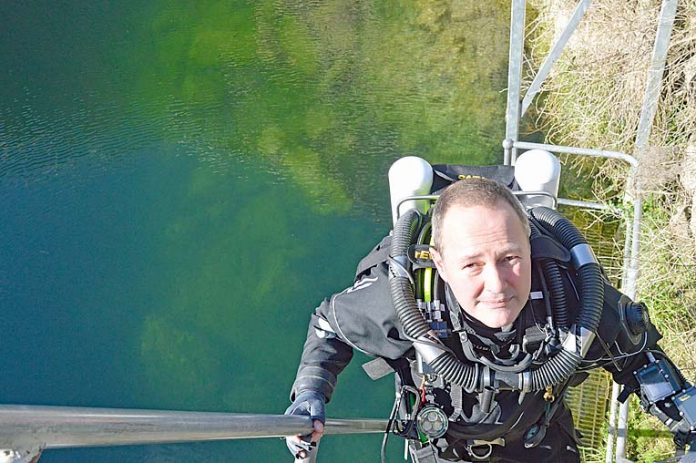
Nowadays divers get access to the entrance lake via a number of dirt steps down the cutting and an impressive wooden deck and steel stairs leading to a platform just beneath the water’s surface.
The overhanging walls of the more circular body of the cenote is riddled with honeycomb cavities about a metre in diameter and a similar passage was found in the cut ramp itself, just a few metres east of the pump-shed.
In early January 1982, a palaeontological team excavated this horizontal passage and recovered fossilised deposits of long-extinct animals including Sarcophilus, Thylacoleo and Sthenurus along with
modern creatures such as bandicoots, possums, snakes, wombats, sheep, rabbits and kangaroos.
Small fish including native trout and (introduced) redfin perch can be seen in the water, as well as yabbies and the much larger freshwater crayfish.
The lake covers an area of around 700 square metres with the widest part being around 29 metres across.
However, the near circular hole is undercut and beneath the water’s surface the cavern’s longest dimension (from southwest to northeast) is around 65 metres.
It reaches a maximum depth of 26 metres at an area named “The Alcove” and features a large rubble pile consisting of around 3000 cubic metres of rock.
The pile slopes to a number of dead trees and many branches at the bottom which makes the hole well suited for line and reel work.
With generally poor visibility the hole is dark with green algae on rotting tree branches and rusting rolls of barbed wire on the sinkhole floor.

It is also cold, and divers often notice the sudden drop in temperature as they pass through the thermoclines – the boundaries between the layers of water.
“Two distinct thermoclines have been observed,” Mr Horne said.
“One at a depth of six metres where the temperature normally drops for around 20C to 16.7C and the second at nine metres where a chillier 13.3C water layer is encountered.”
Unlike other sinkholes, however, the water clarity in Gouldens generally remains the same at depth, and on occasion it actually gets much murkier.
When the water is this dirty, the normally attractive sinkhole can become a cold, black and forbidding place, with divers no longer able to see the surface glow.
But for the vast majority of cavern and cave diving students, Gouldens remains a place of learning new skills under the watchful eye of competent instructors.
Only those accredited with the CDAA are allowed to dive Gouldens Sinkhole.